
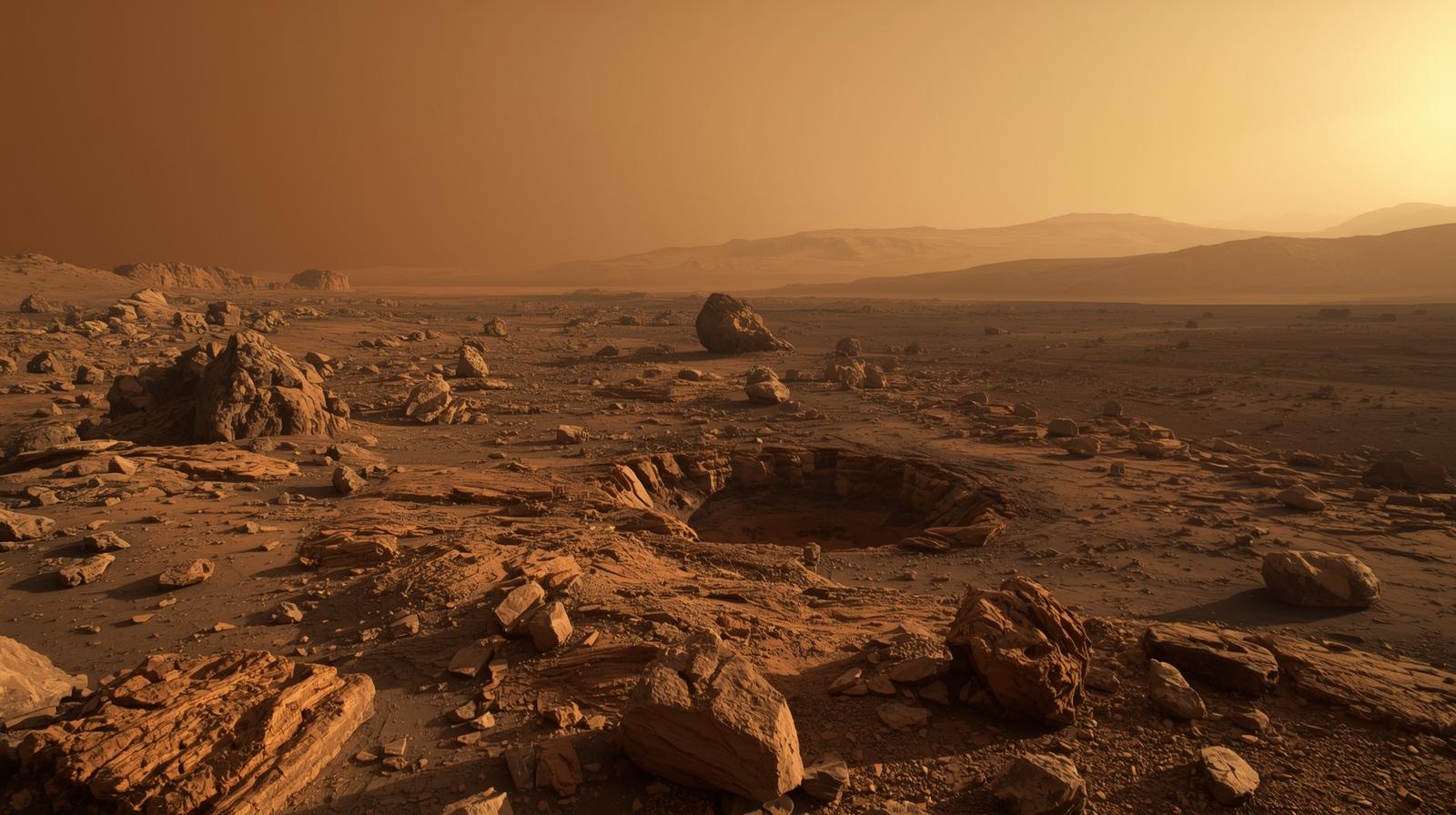
Martian Surface: A Simple Guide to the Land That Shaped the Red Planet
The martian surface looks quiet and empty at first glance. However, when you look closer, it tells a powerful story. Every rock, every valley, and every layer of dust shows us how Mars lived, changed, and survived for billions of years.
This guide explains the martian surface in a simple and human way. You don’t need a science background. You only need curiosity.

What Is the Martian Surface Made Of?
The martian surface is not smooth. Instead, it is rough, dusty, and full of history. Scientists have studied it using orbiters, landers, and rovers for many years.
Rocks, Dust, and Iron-Rich Soil
Most of the surface is covered with fine dust. This dust contains iron minerals. Because of that iron, Mars rusts just like metal does on Earth.
As a result, the entire planet appears red.
The rocks on Mars are mostly volcanic. This tells us Mars had strong internal heat in the past. Over time, the planet cooled. However, the rocks stayed behind as proof.
Why Mars Looks Red
Mars looks red because iron in the soil reacts with oxygen. This process creates rust. That rust spreads everywhere through wind and dust storms.
Because Mars has no strong rain, the rust never washes away. So the red color remains.
Major Features of the Martian Surface
The martian surface holds some of the most extreme landforms in our solar system.
Mountains and Volcanoes
Mars has volcanoes that are much larger than Earth’s.
Olympus Mons: The Giant of the Solar System
Olympus Mons is the tallest volcano we know. It is nearly three times taller than Mount Everest.
Mars has lower gravity. Because of that, lava spread wider instead of building tall cones. Over millions of years, Olympus Mons kept growing.
This tells us Mars was once very active.
Valleys and Canyons
Mars also has deep scars carved into its surface.
Valles Marineris Explained Simply
Valles Marineris is a canyon system longer than the United States. It is so wide that it would stretch across Earth.
Scientists believe it formed as Mars cooled and cracked. Later, flowing water may have shaped it further.
Plains and Impact Craters
Large flat plains cover much of the martian surface. These plains formed from lava flows and meteor impacts.
Mars still shows many craters because it has little erosion. Unlike Earth, Mars has no oceans or heavy rain to erase them.
Signs That Water Once Shaped the Martian Surface
One of the biggest questions in space science is simple: Did Mars ever have water?
The surface says yes.
Ancient Rivers and Lakes
Satellite images show dry riverbeds. Some areas look like old lake shores. These shapes could only form with flowing water.
This means Mars was once warmer and wetter.
If you want deeper insight into how Mars changed over time, this internal resource explains it clearly:
👉 https://astronive.com/2025/12/15/mars-evolution/
Ice Beneath the Surface
Mars still has water today. However, most of it exists as ice. Scientists have found frozen water under the soil near the poles.
This discovery matters because water supports life.
How the Martian Surface Changes Over Time
Mars may look frozen in time, but it still changes.
Dust Storms
Powerful dust storms can cover the entire planet. These storms move soil, shape dunes, and even block sunlight for months.
Rovers have recorded these storms in real time.
Erosion Without Rain
Even without rain, Mars erodes. Wind slowly wears down rocks. Temperature changes crack stones apart.
Change on Mars happens quietly, but it never stops.
Case Study: What Curiosity Rover Taught Us About the Martian Surface
In 2012, NASA’s Curiosity rover landed in Gale Crater. Its mission was simple: study the surface and look for signs of past life.
Curiosity found layered rocks formed in water. It also detected minerals that only form in neutral water, not acidic water.
This discovery proved that Mars once had conditions friendly to life.
According to scientific findings shared in trusted research publications like Science, these surface clues changed how scientists view Mars forever.
Why Studying the Martian Surface Matters for Humans
Understanding the martian surface helps us answer big questions.
- Was Mars ever alive?
- Can humans live there one day?
- What went wrong with its climate?
Mars acts like a warning and a lesson. It shows what can happen when a planet loses its atmosphere.

Conclusion: Mars Is Not Dead — It’s Waiting
The martian surface is more than dust and rock. It is a memory. It remembers water, warmth, and movement.
By studying it, we learn about Mars. At the same time, we learn about Earth and ourselves.
Mars may be silent, but its surface still speaks.
Call to Action
Explore the Scientific Discovery →
👉 https://www.science.org/doi/10.1126/science.153.3733.255

jafir
Jafir Abbas is the visionary founder and owner of Astronive.com, a leading online hub for astronomy enthusiasts, space exploration insights, and cosmic discoveries. With a passion for the mysteries of the universe, Jafir has dedicated his work to making complex astronomical concepts accessible and engaging for readers of all ages. Under his guidance, Astronive.com has become a trusted resource for space news, celestial events, and educational content that inspires curiosity about the cosmos. Jafir combines a keen interest in science with a commitment to clear, engaging communication, bringing the wonders of the universe closer to everyone.
View all posts

