Elliptical Galaxies: Complete Guide to Universe’s Ancient Giants (2025)
Want to know why elliptical galaxies look like glowing cosmic eggs? These ancient star cities are the universe’s oldest survivors. They formed when younger galaxies crashed together billions of years ago. Unlike spiral galaxies with beautiful arms, ellipticals are smooth and round. They hold secrets about how our universe evolved. By the end of this guide, you’ll understand everything about these mysterious cosmic giants.
What Are Elliptical Galaxies?
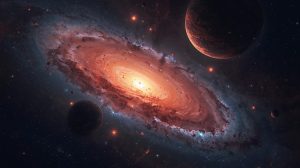
Elliptical galaxies are huge groups of old stars shaped like footballs or basketballs.
They don’t have spiral arms like our Milky Way. Instead, they look smooth and featureless.
Think of them as cosmic snowballs floating in space. They glow with a soft, orange-red light.
Most of their stars formed over 10 billion years ago. Very few new stars are born in elliptical galaxies today.
Scientists find them everywhere in the universe. They make up about 60% of all galaxies we can see.
How Do Elliptical Galaxies Look?
These galaxies come in different shapes.
Some look perfectly round like basketballs. Others appear stretched like rugby balls.
Astronomer Edwin Hubble created a system to classify them in 1926. He used numbers from E0 to E7.
E0 galaxies look like perfect circles. E7 galaxies appear very stretched and oval.
The shape depends on how we see them from Earth. An oval galaxy viewed from the side might look circular from above.
Through a telescope, they appear as fuzzy glowing spots. They don’t show much detail like spiral galaxies do.
The Amazing Birth Story
Elliptical galaxies are born from violent cosmic crashes.
When two spiral galaxies collide, something incredible happens. The crash takes hundreds of millions of years.
First, the galaxies start pulling on each other with gravity. Long streams of stars get ripped away from both galaxies.
Then the galaxies slam together at over 500,000 miles per hour. Gas clouds crash and create millions of new stars quickly.
Finally, the two galaxies merge into one smooth blob. All the beautiful spiral arms disappear forever.
What remains is an elliptical galaxy. It’s like a cosmic graveyard where spiral galaxies go to die.
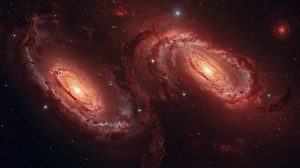
Scientists are watching this happen right now. The Antennae Galaxies are colliding as you read this. In a billion years, they’ll become one giant elliptical.
Similar violent transformations create unique galaxy shapes, like the Cartwheel Galaxy which formed from a dramatic head-on collision.
Why Are They Called “Red and Dead”?
Astronomers have a nickname for elliptical galaxies.
They call them “red and dead.” This name tells their whole story.
Red means they glow with orange-red light. This happens because they only have old stars. Young stars burn blue and white. Old stars burn red and orange.
Dead means no new stars are forming. Spiral galaxies create millions of baby stars every year. Elliptical galaxies create almost none.
They ran out of gas and dust long ago. These materials are needed to make new stars.
Giant black holes at their centers make things worse. They blast away any gas that tries to settle down.
Over trillions of years, elliptical galaxies will just fade away. Their old stars will die one by one.
Key Features That Make Them Special
Elliptical galaxies have some unique traits.
Ancient Stars: Most stars are 10-13 billion years old. Some are among the oldest objects in the universe.
Random Star Movement: Stars zoom around in chaotic paths. In spiral galaxies, stars orbit in organized circles.
Massive Size Range: The smallest are dwarf ellipticals with just 10 million stars. The largest contain over 10 trillion stars.
Hot Gas Halos: They’re surrounded by clouds of super-hot gas. This gas glows at millions of degrees in X-ray light.
Supermassive Black Holes: Every elliptical has a monster black hole at its center. Some weigh billions of times more than our Sun.
Few Globular Clusters: Wait, that’s wrong! Giant ellipticals actually have thousands of globular clusters orbiting them.
Famous Elliptical Galaxies to Know
M87: The Giant Monster
M87 sits 55 million light-years away from Earth.
This supergiant elliptical contains about 1 trillion stars. That’s five times more than our Milky Way.
Its black hole is legendary. Named M87*, it weighs 6.5 billion times more than our Sun.
In 2019, scientists photographed this black hole for the first time ever. The image showed a glowing ring around a dark shadow.
M87 also shoots a powerful jet from its core. This beam stretches 5,000 light-years into space.
Centaurus A: The Dusty Oddball
Centaurus A is only 12 million light-years away.
It’s one of the closest elliptical galaxies we can study. You can even see it with good binoculars.
A thick band of dust cuts across its middle. This shows it recently ate a smaller spiral galaxy.
Its central black hole is super active. It launches jets over a million light-years long.
Radio telescopes show these jets glowing brightly. Centaurus A is one of the brightest radio sources in the sky.
IC 1101: The Ultimate Giant
IC 1101 is one of the biggest galaxies ever found.
It measures 4 million light-years across. That’s 40 times wider than the Milky Way.
This monster contains 100 trillion stars. Its black hole weighs up to 100 billion solar masses.
If you stood at its center, you couldn’t see its edge. Not even with the best telescope humanity can build.
Elliptical vs Spiral Galaxies: Quick Comparison
Let me show you the key differences:
Shape: Ellipticals are smooth ovals. Spirals have beautiful pinwheel arms.
Color: Ellipticals glow red-orange. Spirals shine blue-white in their arms.
Star Formation: Ellipticals make almost no new stars. Spirals birth millions yearly.
Gas Content: Ellipticals have very little gas. Spirals are packed with gas clouds.
Star Ages: Ellipticals have only old stars. Spirals mix young and old stars.
Structure: Ellipticals have no clear pattern. Spirals have organized rotating disks.
Location: Ellipticals cluster together in galaxy groups. Spirals float alone or in small groups.
Where to Spot Them in the Night Sky
You can see elliptical galaxies with your own telescope.
Spring is the best season for northern observers. That’s when the Virgo Cluster appears.
M87 shines at magnitude 8.6 in Virgo constellation. You’ll need at least an 8-inch telescope. It looks like a fuzzy round glow with a bright center.
M49 is easier to find in Virgo. It shines at magnitude 8.4. A 6-inch telescope shows it clearly.
Centaurus A is perfect for southern sky watchers. You can spot it with just binoculars. Through an 8-inch telescope, you’ll see its famous dust lane.
Photography tip: Use long exposures of 5-10 minutes. Stack multiple images to bring out details. Ellipticals are dim, so patience pays off.
Latest Discoveries From 2024-2025
Scientists made exciting discoveries recently.
The James Webb Space Telescope found hidden star formation in some ellipticals. These galaxies aren’t completely dead after all. They make stars very slowly in their dusty cores.
Astronomers detected mysterious fast radio bursts coming from ellipticals. These millisecond flashes weren’t expected from old galaxies.
New surveys found “transition galaxies” caught mid-change. They’re half-spiral and half-elliptical. This proves galaxy transformation is still happening.
Researchers discovered that supermassive black holes control galaxy evolution. They prevent new stars by heating and blasting away gas.
The Future of Elliptical Galaxies
What happens to these ancient galaxies over time?
They slowly fade as their stars burn out. Without new star formation, they grow dimmer every billion years.
In 100 trillion years, all stars will be dead. Elliptical galaxies will become invisible graveyards.
But here’s something wild: Our Milky Way will become an elliptical too.
In 4.5 billion years, we’ll collide with the Andromeda Galaxy. The merger will destroy both spiral structures.
The result will be a giant elliptical galaxy. Scientists already named it “Milkomeda.”
Why Should You Care About Elliptical Galaxies?
These galaxies teach us important lessons.
They show how galaxies evolve over cosmic time. Every spiral galaxy might become an elliptical eventually.
They help us understand dark matter. By watching star movements, we map invisible matter.
They reveal black hole growth. We learn how monsters weighing billions of Suns form.
They preserve ancient history. Their old stars record what the early universe was like.
For space enthusiasts, they’re cosmic time machines. Looking at ellipticals means seeing the universe’s ancient past.
Frequently Asked Questions
Q: Are elliptical galaxies bigger than spiral galaxies?
A: They range from tiny to gigantic. Dwarf ellipticals are smaller than the Milky Way. But supergiant ellipticals are the biggest galaxies in the universe.
Q: Can elliptical galaxies form spiral arms again?
A: No, once spiral arms are destroyed, they never come back. The random star orbits make it impossible to form organized spirals again.
Q: How long does a galaxy collision take?
A: About 500 million to 1 billion years. That might sound long, but it’s quick in cosmic time.
Q: Do elliptical galaxies have planets?
A: Yes! Their stars can have planets just like spiral galaxy stars. But finding them is harder because ellipticals are so far away.
Q: What’s the youngest elliptical galaxy?
A: Some formed just 2-3 billion years ago from recent galaxy mergers. Others formed over 10 billion years ago and are ancient.
Q: Can we see elliptical galaxies with naked eyes?
A: No, they’re too dim. You need at least binoculars or a small telescope to spot them.
Final Thoughts
Elliptical galaxies are the universe’s senior citizens.
They formed from violent crashes billions of years ago. Now they drift peacefully through space.
These smooth, red-glowing spheres tell amazing stories. They show us what happens when galaxies collide.
They prove that even mighty spiral galaxies eventually die. Everything in the universe has a beginning and an end.
Next time you look at the night sky, remember this. Billions of elliptical galaxies are out there.
Each one was once a beautiful spiral like our Milky Way. Each one experienced cosmic catastrophe and survived.
And someday, our galaxy will join them. We’ll become an elliptical too.
Want to learn more about incredible cosmic phenomena? Check out resources from NASA’s Universe Education Hub for the latest space discoveries. Keep exploring the cosmos and never stop asking questions about our amazing universe.

jafir
Jafir Abbas is the visionary founder and owner of Astronive.com, a leading online hub for astronomy enthusiasts, space exploration insights, and cosmic discoveries. With a passion for the mysteries of the universe, Jafir has dedicated his work to making complex astronomical concepts accessible and engaging for readers of all ages. Under his guidance, Astronive.com has become a trusted resource for space news, celestial events, and educational content that inspires curiosity about the cosmos. Jafir combines a keen interest in science with a commitment to clear, engaging communication, bringing the wonders of the universe closer to everyone.
View all posts