Types of Black Holes: What Every Space Fan Must Know
Not all black holes are the same. In fact, they are wildly different. Some weigh as much as a million suns. Others are small enough to fit in a room. Furthermore, some may not even exist yet in proven science. So, if you think a black hole is just a black hole — think again. There are four main types of black holes. Each one is stranger than the last. Understanding them, therefore, will change how you see the universe forever. Let’s dive in.
What Is a Black Hole?
First, let’s get the basics right. A black hole is a place in space. Gravity there is so strong that nothing escapes. Not light. Not matter. Nothing at all. This happens because too much mass is packed into too small a space. As a result, gravity becomes extreme beyond imagination.
The outer edge of a black hole is called the event horizon. Cross it, and you cannot return. Moreover, according to NASA, all black holes spin. The fastest one spins over 1,000 times per second. That alone shows how extreme they truly are.
Scientists sort black holes by one key thing — mass. In other words, how heavy they are. That single number, therefore, tells us everything.
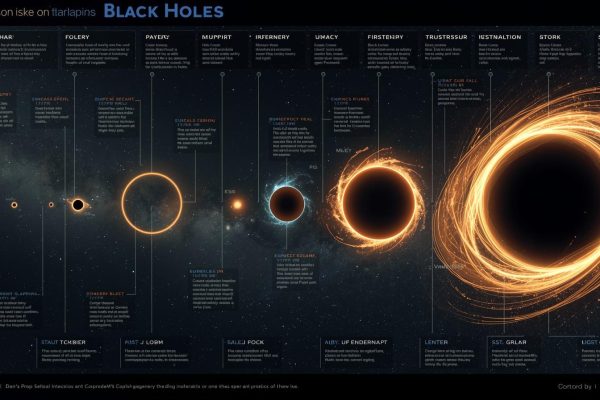
The 4 Main Types of Black Holes
There are four main types of black holes. Each one forms differently. Each one also behaves differently. So, let’s break them all down clearly and simply.
1. Stellar Black Holes
Stellar black holes are the most common type. They are also the easiest to understand. Essentially, they are born from dying stars. However, not just any star. Only stars at least 20 to 25 times heavier than our Sun can create one.
Here is how it works. A massive star burns fuel for millions of years. Eventually, the fuel runs out. Without fuel, the outward pressure of fusion stops. As a result, gravity takes over instantly. The star’s core collapses in under a second. Then a violent explosion called a supernova rips the star apart. What remains, therefore, is a stellar black hole.
Their mass ranges from around 3 to 50 times our Sun. However, don’t be fooled by that “small” size. The lightest known one has a mass 3.3 times our Sun. Yet it is only 19.5 kilometres across. For comparison, that is smaller than most cities. Furthermore, our Milky Way alone may hold up to 100 million stellar black holes. However, we have only confirmed around 50 so far.
How Do We Find Stellar Black Holes?
Finding them is tricky. After all, they emit no visible light. However, astronomers are clever. When a stellar black hole has a companion star nearby, it pulls gas from it. That gas then heats up dramatically. As a result, it glows brightly in X-rays. This X-ray glow, therefore, reveals the hidden black hole.
There is also something most articles miss entirely. Stars between 130 and 250 times the Sun’s mass do not form black holes. Instead, they undergo a pair-instability supernova. They blow themselves apart completely. Nothing is left behind. This means, therefore, there is a natural mass gap in stellar black holes that most people never hear about.
2. Supermassive Black Holes
If stellar black holes are lions, supermassive black holes are entire continents. They are monstrous. Their mass ranges from hundreds of thousands to tens of billions of solar masses. Furthermore, the largest ever found, TON 618, weighs 66 billion times our Sun. That number is almost impossible to imagine.
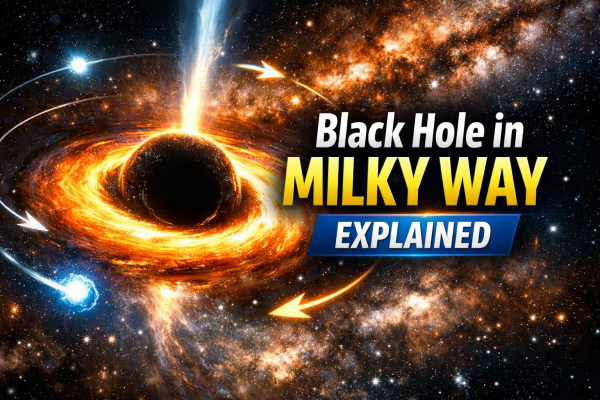
Almost every large galaxy has one at its centre. Ours is no different. Our galaxy’s central black hole is called Sagittarius A*. It has a mass of about 4 million Suns. However, compared to TON 618, it is relatively modest. Astronomers confirmed its existence by tracking nearby stars for decades. That work, moreover, earned the 2020 Nobel Prize in Physics.
How Do Supermassive Black Holes Grow?
This is where things get really interesting. Scientists believe they grow by eating surrounding gas and dust. Additionally, they grow by merging with other black holes over billions of years. However, recent discoveries have confused everything.
The James Webb Space Telescope found supermassive black holes that were enormous just 1.5 billion years after the Big Bang. That is far too big, far too fast, under old models. Furthermore, one black hole called LID-568 was found consuming matter 40 times faster than the theoretical limit. As a result, scientists are rethinking everything they thought they knew.
The Accretion Disk and Jets
When a supermassive black hole feeds actively, it creates something stunning. The infalling gas forms a spinning accretion disk. This disk glows so brightly it can outshine an entire galaxy. Moreover, some black holes also fire enormous jets of plasma from their poles at near-light speed. One such jet system, named Porphyrion, stretches 23 million light-years in length. That, therefore, equals 140 Milky Ways laid end to end.
To go deeper on black hole formation, read our full guide on astrophysics and black hole formation.
3. Intermediate-Mass Black Holes
This category is arguably the most exciting right now. Intermediate-mass black holes, or IMBHs, sit in the mass range between 100 and 100,000 solar masses. In other words, they fall between stellar and supermassive types. However, for a long time, scientists thought this range was essentially empty.
The physics of stellar collapse could not produce them. Meanwhile, whatever creates supermassive black holes seemed to skip this range entirely. Scientists, therefore, called them the “missing link” of black hole science. That name stuck for good reason.
The LIGO Discovery That Changed Everything
However, everything changed in 2019. The LIGO gravitational wave detector picked up a signal called GW190521. This signal came from two black holes merging. The result was a 142 solar-mass black hole. That placed it firmly in intermediate territory. Additionally, another event, GW231123, was detected in November 2023. As a result, the evidence for IMBHs is now growing fast.
Candidates have also been found in globular clusters, dwarf galaxies, and star-forming regions. One strong candidate, 3XMM J215022.4-055108, has a mass 50,000 times our Sun. Moreover, it sits about 740 million light-years away.
Why IMBHs Matter So Much
Understanding intermediate-mass black holes is critical. They may, in fact, be the key to understanding how supermassive black holes grew. The leading theory suggests IMBHs formed early in the universe. They then merged repeatedly over billions of years. As a result, they eventually became the supermassive giants at galactic centres.
There is also something most articles miss. Scientists now describe “lite IMBHs” — black holes too massive for stellar collapse but not quite big enough for the traditional IMBH category. They sit in a mass gap between roughly 60 and a few hundred solar masses. Furthermore, they are currently one of the hottest frontiers in gravitational wave research.
4. Primordial Black Holes
These are the most mysterious of all. In fact, they are the only type without a single confirmed detection. Yet they are also the most fascinating. The idea was first explored seriously by the late physicist Stephen Hawking. He proposed that, in the very first second after the Big Bang, the universe was incredibly dense and chaotic. In such conditions, pockets of matter could collapse directly into black holes. No star required. No supernova needed. Just pure pressure from the early universe’s chaos.
Their Incredible Size Range
Their potential mass range is staggering. Theory suggests they could range from 100,000 times lighter than a paperclip to 100,000 times heavier than our Sun. The smallest ones, however, would have already vanished. They evaporate slowly through a process called Hawking radiation. This is the gradual loss of energy at the event horizon. Larger ones, on the other hand, might still exist today. They could, therefore, be drifting silently through space right now.
The Dark Matter Connection
One of the most thrilling possibilities involves dark matter. Dark matter makes up roughly 27% of the universe. Yet it has never been directly detected. If primordial black holes exist in huge numbers, they could account for some or all of dark matter’s gravitational effects. No definitive proof exists yet. However, this remains a serious and active field of research.
Additionally, primordial black holes may have acted as seeds in the early universe. They may have been gravitational anchors around which matter gathered over time. As a result, they could explain how supermassive black holes appeared so early in cosmic history.
How All Four Types of Black Holes Compare
| Type | Mass Range | How They Form | Confirmed? |
|---|---|---|---|
| Stellar | 3–50 solar masses | Dying massive stars | Yes |
| Intermediate | 100–100,000 solar masses | Star mergers, dense clusters | Partially |
| Supermassive | 100,000+ solar masses | Galaxy formation processes | Yes |
| Primordial | Tiny to vast | Early universe density | Not yet |
What Happens If You Fall Into a Black Hole?
This is the question everyone asks. So, let’s answer it properly. From outside the black hole, you would appear to slow down. You would grow dimmer. You would grow redder. Eventually, you would seem to freeze completely at the event horizon. You would never appear to actually cross it.
However, from your own perspective, things are different. Crossing the event horizon of a large black hole might feel surprisingly uneventful at first. But, as you fall deeper, tidal forces grow extreme. They would stretch you vertically and crush you sideways. Physicists call this process spaghettification. Finally, everything converges on the singularity. There, our current understanding of physics breaks down completely.
Moreover, the closest known black hole to Earth is Gaia BH1. It sits about 1,500 light-years away. That is, therefore, no immediate threat to worry about.
Why Black Holes Shape the Entire Universe
Black holes are not just passive holes in space. They are, in fact, active architects of the cosmos. Supermassive black holes regulate star formation across entire galaxies. The jets and radiation they emit, therefore, control how fast stars are born. Meanwhile, stellar black holes leave gravitational fingerprints on companion stars nearby.
Furthermore, intermediate-mass black holes — once confirmed in greater numbers — may rewrite our entire story of galactic evolution. Additionally, if primordial black holes are real, they could finally solve the dark matter mystery that has puzzled scientists for decades. In short, every type of black hole plays a role. Each one, therefore, matters enormously.
Frequently Asked Questions About Types of Black Holes
How many types of black holes are there? There are four types: stellar, supermassive, intermediate-mass, and primordial. However, only primordial black holes have not yet been confirmed by direct observation.
Which type is the most common? Stellar black holes are by far the most common. The Milky Way alone, for example, may contain up to 100 million of them.
Is there a black hole in our galaxy? Yes. Sagittarius A* sits at the centre of the Milky Way. It has a mass roughly 4 million times that of our Sun. Moreover, its existence was confirmed by decades of stellar orbit tracking.
Can a black hole destroy Earth? Not any time soon. The nearest known black hole, Gaia BH1, is 1,500 light-years away. Furthermore, black holes do not act like vacuum cleaners. They only pull in what comes very close.
What is the biggest type of black hole? Supermassive black holes are the largest confirmed type. TON 618, for instance, has a mass of 66 billion Suns. Some ultramassive candidates may, however, push even beyond that.
Did Stephen Hawking discover a type of black hole? Hawking theorised the existence of primordial black holes. He also developed the concept of Hawking radiation. Both ideas, therefore, remain among the most influential in theoretical physics today.
What is the difference between stellar and supermassive black holes? The key difference is scale and origin. Stellar black holes form from individual dying stars. Supermassive ones, on the other hand, sit at galactic centres and contain billions of solar masses. Their formation processes are also still not fully understood.
Conclusion
The universe does not deal in simple answers. There are four known types of black holes. Each one is born differently. Each one also behaves differently. Together, however, they shape everything — from single stars to entire galaxies. Stellar black holes are the most common. Supermassive ones are the most powerful. Intermediate-mass ones, meanwhile, may hold the key to cosmic history. Primordial ones, furthermore, could solve the greatest mystery in modern science.
What makes this all so exciting is that the story is not over. Gravitational wave detectors are picking up mergers we never expected. The James Webb Space Telescope is finding black holes where they should not yet exist. And somewhere out there, primordial black holes may be drifting through the dark, waiting to be found. The more we learn about the types of black holes, therefore, the more we understand our own place in this extraordinary universe.
Sources: NASA Science, ScienceDaily, The Conversation, Wikipedia — Intermediate-mass Black Holes

jafir
Jafir Abbas is the visionary founder and owner of Astronive.com, a leading online hub for astronomy enthusiasts, space exploration insights, and cosmic discoveries. With a passion for the mysteries of the universe, Jafir has dedicated his work to making complex astronomical concepts accessible and engaging for readers of all ages. Under his guidance, Astronive.com has become a trusted resource for space news, celestial events, and educational content that inspires curiosity about the cosmos. Jafir combines a keen interest in science with a commitment to clear, engaging communication, bringing the wonders of the universe closer to everyone.
View all posts