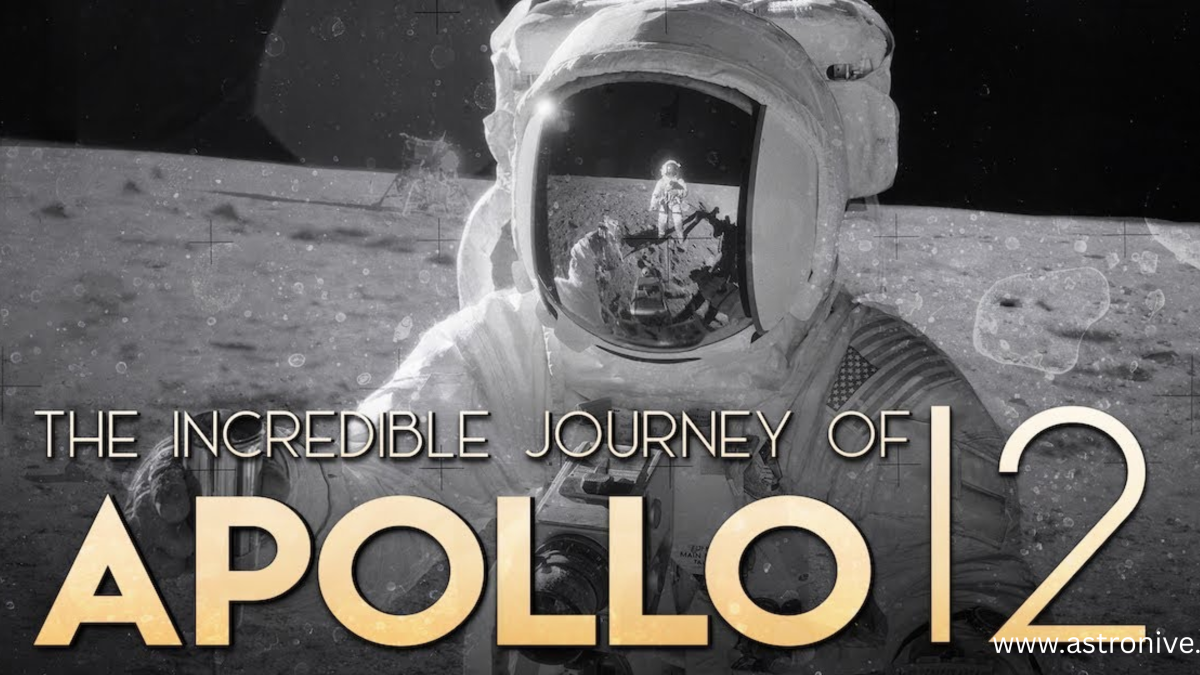
Apollo 12: The Story of the Second Human Moon Landing That Changed Space Exploration Forever
Imagine looking up at the night sky, curious and wondering what lies beyond our world. Now picture human beings not just looking — but walking across the surface of the Moon, exploring new lands, collecting rocks, and bringing them back to Earth. That was the essence of Apollo 12 — a mission that didn’t just reach the Moon but proved we could land with precision and do serious science while there.
Apollo 12 wasn’t just another spaceflight. It was a bold leap forward in human ingenuity, bravery, and curiosity — and its success shaped how we explore space even today. (NASA)
🚀 What Was Apollo 12?
Apollo 12 was the United States’ second crewed lunar landing mission, launched on 14 November 1969 just months after the first Moon landing. Its focus was clear: not just to land on the Moon again, but to land exactly where NASA scientists wanted — a precision landing close to the unmanned Surveyor 3 spacecraft. (NASA)
This mission showed the world that humanity didn’t just reach the Moon — we could control our path to it.

👨🚀 The Crew That Made History
Apollo 12 carried three brave astronauts:
- Commander Charles “Pete” Conrad, Jr.
- Lunar Module Pilot Alan L. Bean
- Command Module Pilot Richard F. Gordon Jr.
These three explorers worked as a team — from launch to lunar surface operations and safe return to Earth. (NASA)
🌑 Launch, Lightning, and Precision Landing
The mission began under dramatic skies. As Apollo 12 lifted off from Cape Kennedy, Florida, lightning struck the launch vehicle twice shortly after liftoff. That moment could have ended the mission — but quick thinking and skilled engineering kept the spacecraft on course. (NASA)
Five days into the mission, the Lunar Module Intrepid touched down on the Moon’s Ocean of Storms just a few hundred feet from the robotic Surveyor 3 lander that had arrived there in 1967. This was a pinpoint landing, crucial proof that lunar navigation could be controlled with remarkable accuracy. (LPI)
🔬 Scientific Work on the Moon
Once on the Moon, Conrad and Bean stepped out and spent more than 7 hours walking on the lunar surface. They:
- Deployed scientific instruments that would send back data for years
- Collected more than 34 kilograms (75 pounds) of lunar rocks and soil
- Returned pieces of the Surveyor 3 spacecraft, giving scientists earthly insight into how the Moon affects man-made materials in a space environment (LPI)
These samples and experiments helped researchers understand the Moon’s composition, seismic activity, and history — all valuable for future exploration.
🌍 Life in Lunar Orbit
While his colleagues walked on the Moon, Richard Gordon remained in lunar orbit aboard the Command Module Yankee Clipper. His role was vital — providing support from above and capturing key photographic data that would help future missions. (LPI)
📅 Mission Timeline Snapshot
| Phase | Key Events |
|---|---|
| Launch | 14 Nov 1969 |
| Lunar Landing | 19 Nov 1969 |
| Moonwalks (EVAs) | ~7.5 hours |
| Return to Earth | 24 Nov 1969 |
Overall, Apollo 12 lasted 10 days, 4 hours and 36 minutes, traveling more than 950,000 miles between Earth, lunar orbit, and back. (spaceline.org)
💡 Why Apollo 12 Matters
Apollo 12’s success wasn’t just about walking on the Moon again — it was about precision and purpose:
🎯 1. Precision Landing Excellence
The mission showed that spacecraft could be directed to very specific lunar coordinates — a critical skill for future missions to rugged or scientifically interesting locations. (Planetary Society)
🌒 2. Scientific Breakthrough
The moon rocks and experiments brought back data that helped scientists learn more about the Moon’s interior structure, age, and geological history. (NASA Science)
🧠 3. Building Confidence for Future Exploration
Apollo 12 proved that humans could reliably reach the Moon, carry out complex tasks, and return safely — inspiring the Apollo 13 rescue, Apollo 14-17’s science focus, and future ambitions like Artemis. (NASA)
🤔 FAQs About Apollo 12
1. What was the main goal of Apollo 12?
The main goal was a successful precision lunar landing, collecting samples and setting up science experiments. (NASA)
2. Did Apollo 12 face any problems?
Yes — lightning struck the Saturn V rocket during launch — but quick action saved the mission. (NASA)
3. What did the astronauts bring back?
They brought more than 75 pounds of lunar rocks and soil, along with parts of the Surveyor 3 spacecraft. (LPI)
4. Did all crew walk on the Moon?
No — Conrad and Bean walked on the surface, while Gordon remained in lunar orbit. (LPI)
🔗 Further Reading
For more about the earlier historic Moon landing that made Apollo 12 possible, see:
👉 Internal link: https://astronive.com/missions/apollo-11/
And for authoritative details from NASA, visit:
👉 NASA Apollo 12 Mission Overview — https://www.nasa.gov/missions/apollo/apollo-12/
🌟 Conclusion
Apollo 12 was not a repeat performance — it was a refinement of human skill at landing on another world. With precision, purpose, and passion, the mission expanded what we knew about the Moon and confirmed that humans could not only reach distant places, but also explore them with careful intention.
It stands as a testament to human courage, scientific curiosity, and the belief that we can reach even farther tomorrow. (NASA)